SOC as a Service for Australian SMEs: Benefits, Costs, and How It Works

Cyber threats are becoming more frequent, sophisticated, and costly for Australian businesses. The Australian Cyber Security Centre (ACSC) reported over 94,000 cybercrime incidents in FY2023–24 — approximately one report every six minutes — highlighting the growing risk for Australian businesses of all sizes. The ACSC continues to publish detailed findings through its Annual Cyber Threat Report.
SOC as a Service (SOCaaS) offers a practical alternative to building and managing an internal security operation. Instead of creating a dedicated team and investing in specialist technology, businesses can access security operations through a trusted third-party provider.
For many SMEs (Small and Medium Enterprises), this can provide improved visibility, more consistent security monitoring, and access to cybersecurity expertise without the cost and complexity of running an in-house SOC.
What is SOC as a service?
SOC as a Service is a managed cybersecurity solution that delivers the capabilities of a security operations centre through an external provider. Rather than building an internal function from the ground up, organisations outsource security monitoring, investigation, and response activities to a team of cybersecurity specialists.
A typical SOCaaS solution combines monitoring, threat intelligence, alert management, reporting, and incident response into a single service.
SOCaaS often incorporates MDR (Managed Detection and Response) capabilities but focuses more broadly on continuous monitoring, alert triage, and security operations management rather than endpoint-only detection and response. Understanding the difference between SOCaaS and MDR or XDR can help organisations choose the right model for their environment.
How does SOC as a service work?
A SOC functions as a centralised capability for monitoring security activity across an organisation’s environment.
To get started, data sources such as endpoints, firewalls, cloud services, servers, and business applications are connected to the monitoring platform. This process typically involves log ingestion, normalisation, and correlation across multiple data sources to create a unified security view. Security platforms then analyse that information using correlation rules, analytics, and automated detections, while analysts investigate prioritised alerts and potential threats.
When unusual activity is detected, the provider assesses the event and determines whether further investigation or escalation is required.
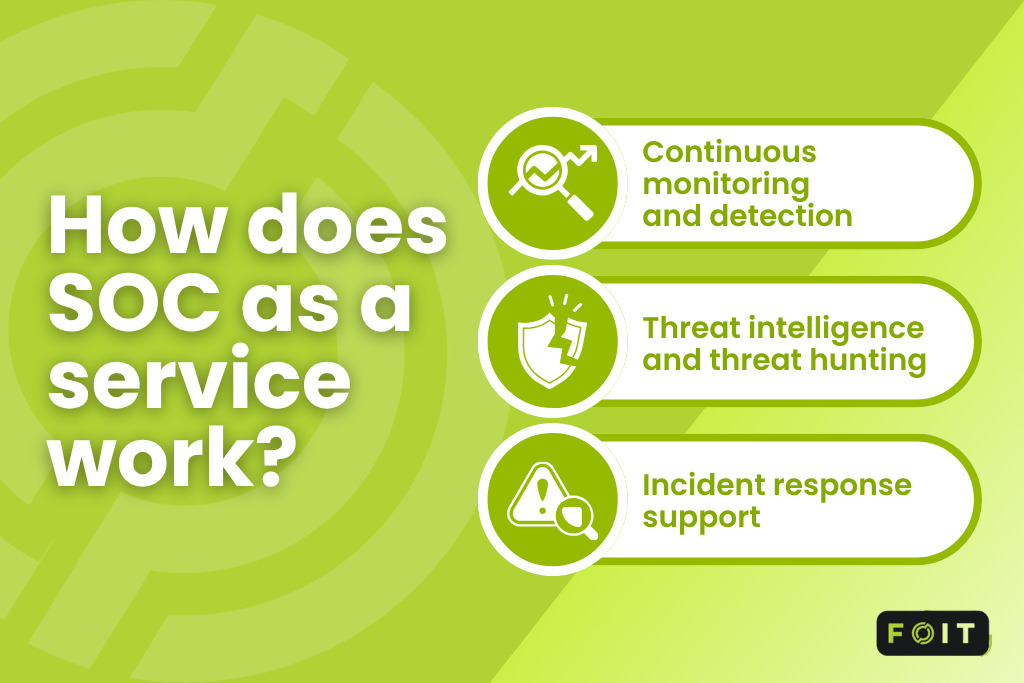
Continuous monitoring and detection
One of the main reasons businesses adopt SOC as a Service is access to continuous monitoring.
Security events are collected and analysed around the clock, helping organisations identify suspicious activity that may otherwise go unnoticed when sufficient data sources are integrated and properly configured. Many providers use SIEM, XDR, MDR platforms, or a combination of detection and response technologies to improve visibility across the environment.
Many providers also use SOAR (Security Orchestration, Automation and Response) tools to automate response actions and reduce false positives, allowing analysts to focus on high-priority threats.
When properly implemented, these technologies can help organisations improve threat detection and respond to cyber threats more effectively.
Threat intelligence and threat hunting
Cyber threats evolve constantly, making ongoing visibility essential. Many SOCaaS providers use threat intelligence feeds to help detect known attack techniques and provide context on emerging threats. Some providers map detections against frameworks such as MITRE ATT&CK to improve visibility into attacker behaviour and techniques. Some providers also offer proactive threat hunting, although this is often included as part of advanced service tiers.
This additional context helps organisations make more informed security decisions.
Incident response support
Identifying a threat is only one part of effective cybersecurity. When a security event is confirmed, the SOC team helps coordinate incident response activities. Depending on the service, this may include investigation, containment recommendations, escalation support, recovery guidance, or in some cases, active response actions.
The level of response available will vary between providers and service agreements.
What is included in managed SOC services?
Most managed SOC services provide a combination of monitoring, analysis, and response capabilities. While specific features differ between providers, the objective is generally the same: helping organisations identify potential threats sooner and respond more effectively.
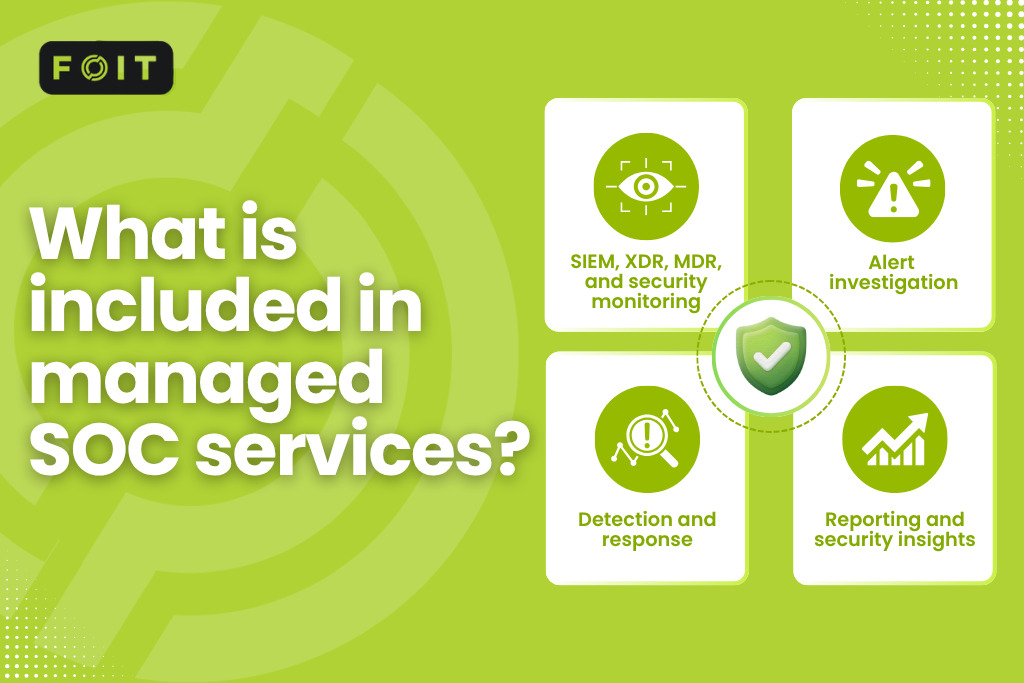
SIEM, XDR, MDR, and security monitoring
Modern SOC environments often rely on a combination of SIEM, XDR, and MDR technologies. These platforms collect and correlate security data from across the organisation, providing a centralised view of available security data and helping analysts investigate unusual behaviour more efficiently. This visibility forms the foundation of effective managed security operations.
Alert investigation
Not every alert represents a genuine threat. One of the key responsibilities of a security analyst is investigating alerts, validating risks, and filtering out false positives. This helps businesses focus on events that genuinely require attention.
Detection and response
A quality managed SOC does more than generate alerts. It combines monitoring with practical detection and response capabilities, helping organisations understand risks and determine the most appropriate course of action when threats are identified. Many providers also offer managed detection and response as part of a broader range of services.
Reporting and security insights
Most providers deliver regular reporting covering security events, monitoring trends, incident activity, and overall performance. These insights help organisations identify gaps, improve visibility, and strengthen their security posture over time.
Log retention and audit support
Many services also include log retention and audit support to assist with investigations and compliance requirements. Retained logs can be critical during incident investigations and for organisations working towards frameworks such as the ASD Essential Eight and ISO 27001.
SOCaaS vs an in-house SOC
Businesses evaluating SOC as a Service often compare it with building an internal capability. While both approaches can improve cybersecurity outcomes, the decision usually comes down to resources, expertise, and long-term investment. Building an in-house SOC in Australia can cost hundreds of thousands of dollars annually, depending on staffing and tooling requirements.
Building an in-house SOC
An in-house SOC provides direct control over security operations, technology, and processes. However, building and maintaining that capability often requires significant investment in security platforms, infrastructure, training, and specialised staff. Providing continuous coverage can also be difficult for smaller organisations.
Using a managed SOC provider
A managed SOC provider delivers many of the same capabilities through a subscription-based model. Instead of recruiting analysts and managing operations internally, organisations gain access to established processes, specialist expertise, and continuous monitoring support.
For many SMEs, this approach can be more achievable than maintaining an internal SOC.
Comparing the two approaches
For many businesses, the decision comes down to whether they want to manage security operations internally or work with a specialist provider.
SOC as a Service for Australian SMEs
Australian SMEs face unique challenges when it comes to cybersecurity. Budget constraints, limited in-house expertise, and a growing threat landscape make it difficult to maintain the level of monitoring that modern businesses require. Managed SOC services across Australia offer a scalable path to 24/7 security monitoring without the overhead of building an internal team. For organisations exploring cybersecurity services for SMEs in Australia, SOCaaS represents one of the most practical ways to close the gap between current security maturity and where they need to be.
Benefits of SOC as a service for Australian businesses
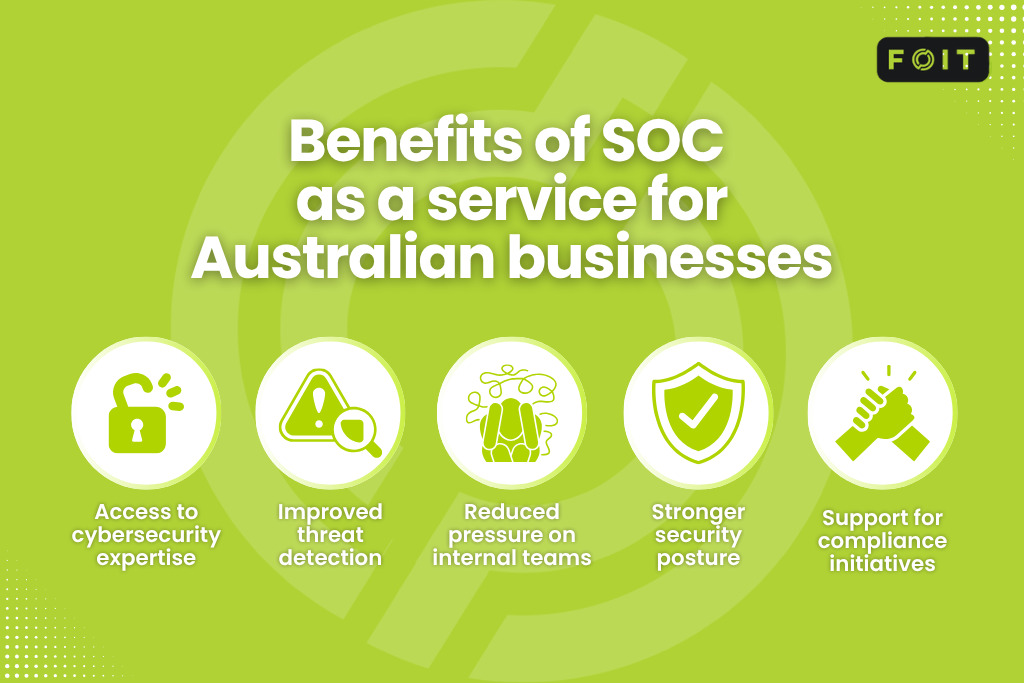
The value of SOC as a Service extends beyond monitoring alone. For many organisations, it provides access to skills, technologies, and operational processes that may otherwise be difficult or expensive to maintain internally.
Access to cybersecurity expertise
Cybersecurity professionals remain in high demand across Australia, with ongoing skills shortages reported across the industry. A managed SOC provides access to experienced analysts, incident responders, and threat hunters without the challenges associated with recruiting and retaining specialised staff.
Improved threat detection
Continuous monitoring, combined with threat intelligence and advanced analytics, can help organisations identify suspicious activity more quickly. Earlier detection can significantly reduce dwell time — the period between initial compromise and discovery — which is a key factor in limiting financial and operational impact. The effectiveness of threat detection depends on factors such as visibility, integrations, data quality, and the provider’s operational maturity.
Reduced pressure on internal teams
Many internal IT teams already manage a broad range of responsibilities. Outsourcing monitoring and investigation activities allows businesses to strengthen security without placing additional pressure on their existing security team.
Stronger security posture
Regular monitoring, reporting, and proactive investigation can help organisations identify weaknesses and improve security practices over time. This contributes to a stronger security posture and better preparedness for evolving security threats.
Support for compliance initiatives
Many organisations use SOC services to strengthen governance and compliance efforts. Based on ACSC guidance, continuous monitoring is a key pillar of effective cyber resilience. Monitoring and reporting can support security programs aligned with frameworks such as the ASD Essential Eight, ISO 27001, and other industry requirements.
How much does SOCaaS cost?
There is no standard approach to SOCaaS pricing because costs vary depending on business size, infrastructure, monitoring requirements, and service scope. Pricing models often include per-endpoint, per-user, or data-ingestion-based (GB/day) structures depending on the provider.
Common factors that influence pricing include:
- Number of users
- Number of endpoints
- Cloud environments
- Compliance requirements
- Monitoring coverage
- Incident response requirements
- Reporting needs
For SMEs in Australia, SOCaaS pricing often starts from a few hundred dollars per month for basic monitoring and scales based on data volume and coverage. Compared with building and maintaining a fully staffed internal SOC, particularly when 24/7 coverage is required, a managed SOC service is often the more cost-effective option for SMEs.
How to choose the right SOC provider
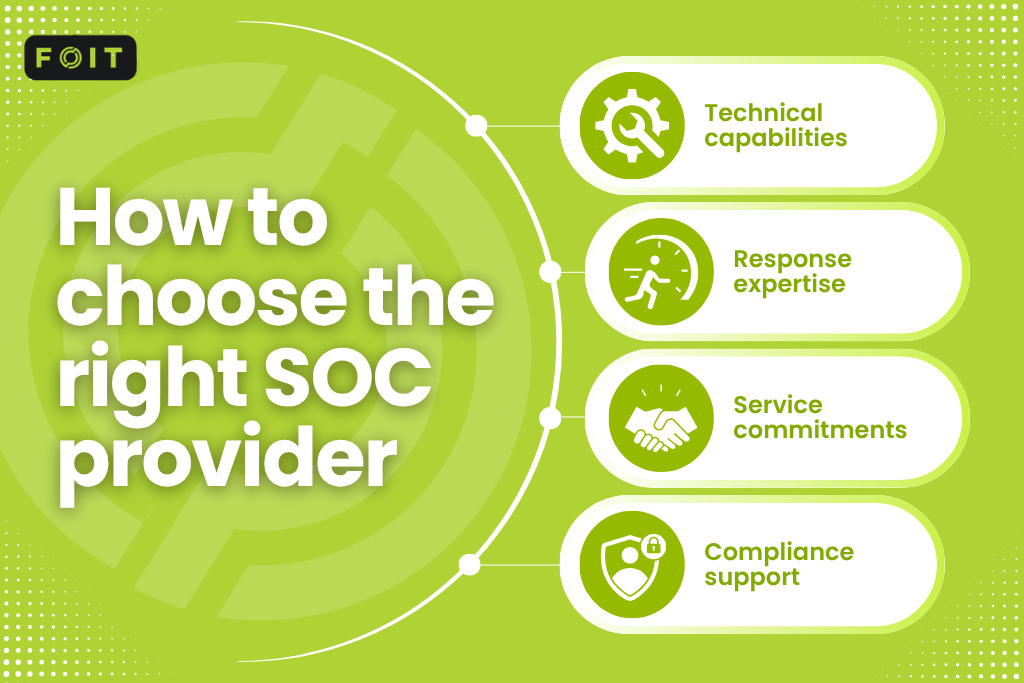
Not all providers deliver the same level of service. Using a structured SOC provider checklist can help ensure all critical areas are evaluated. When assessing an outsourced SOC provider Australia-wide, it is important to understand how the service aligns with your technology environment, security objectives, and operational requirements.
Technical capabilities
Look for a provider that can integrate with your existing security tools and broader security stack. Strong integration capabilities can improve visibility across the environment and help organisations maximise their existing security investments.
Response expertise
Monitoring is important, but response capabilities are equally critical. Understanding how incidents are investigated, escalated, and managed can help establish realistic expectations before engaging a provider.
Service commitments
Review service level agreements carefully. Response times, communication processes, reporting obligations, and escalation procedures should be clearly defined.
Compliance support
If your organisation operates in a regulated environment, ask how the provider supports compliance requirements. Many SOC services assist organisations working towards frameworks such as the ASD Essential Eight, ASD Essential Eight maturity levels, and ISO 27001 through monitoring, reporting, and security visibility.
Why more businesses are considering SOC as a service
As cyber threats continue to evolve, businesses need practical ways to improve visibility, strengthen monitoring, and respond to incidents effectively.
Many organisations already have security tools in place but limited capacity to monitor and manage them consistently. SOC as a Service helps address that challenge by combining specialist expertise, continuous monitoring, and structured incident response into a more manageable approach to cybersecurity.
For many Australian SMEs, the goal is not necessarily to build a large internal security operation. It is to ensure potential threats are identified, investigated, and addressed appropriately while allowing internal teams to remain focused on broader business priorities.
If you’re evaluating SOCaaS for your organisation, FOIT can help. Our team works with Australian SMEs to assess their security monitoring needs and identify the right approach for their environment. Contact us to learn more about our managed cybersecurity services and incident response planning support.
Frequently asked questions
How quickly can a SOC provider respond to a cyber threat?
Response times depend on the provider’s processes, service level agreements, and the severity of the incident. Many managed SOC services begin investigating high-priority alerts as soon as they are detected. Faster escalation can help reduce business disruption.
Do small businesses need 24/7 security monitoring?
Many small businesses benefit from 24/7 monitoring because cyber attacks can happen at any time. Continuous monitoring improves visibility and helps identify suspicious activity outside normal business hours.
Can SOC as a Service help with compliance requirements?
Yes. Many SOC providers support compliance efforts through monitoring, reporting, incident tracking, and security visibility. This can assist organisations working towards frameworks such as the ASD Essential Eight and ISO 27001.
What types of threats can a managed SOC detect?
A managed SOC can detect a wide range of threats when appropriate data sources and integrations are in place. Examples include ransomware, phishing attacks, malware, suspicious user behaviour, and unauthorised access attempts.
How long does it take to implement SOC as a Service?
Implementation timelines vary depending on the environment being monitored. Smaller organisations may be onboarded within a few weeks, while larger or more complex environments can take several months.
What should businesses ask before choosing a SOC provider?
Businesses should ask about monitoring coverage, response processes, reporting capabilities, service level agreements, and integration with existing security tools. These details help determine whether the provider is the right fit.
Can a managed SOC work with existing security tools?
Yes. Most managed SOC providers integrate with existing technologies such as firewalls, endpoint protection platforms, cloud environments, SIEM solutions, and other security tools.
What is the difference between SOC as a Service and MDR?
SOCaaS provides broader security operations including monitoring, alert triage, and reporting across the full environment, while MDR focuses primarily on endpoint detection and response. Many SOCaaS offerings include MDR capabilities as part of a wider service.
Is SOC as a Service suitable for small businesses in Australia?
Yes. SOCaaS is well-suited to small and medium businesses in Australia because it removes the need to recruit specialist security staff or invest in expensive monitoring platforms. Subscription-based pricing and flexible service tiers make it accessible for organisations at various stages of security maturity.
Do SOC providers replace internal IT teams?
No. A managed SOC provider works alongside internal IT teams rather than replacing them. The SOC handles security monitoring, threat investigation, and incident response, while internal teams continue to manage day-to-day IT operations. This collaboration can reduce the security burden on existing staff without removing their involvement in the organisation’s technology environment.
How is SOC as a Service different from traditional IT support?
SOC as a Service focuses on cybersecurity monitoring, threat detection, investigation, and incident response. Traditional IT support focuses on maintaining systems, resolving technical issues, and supporting day-to-day operations.