Cyber threats now generate more alerts and data than many security teams can review manually. That is why AI in cybersecurity has become one of the most talked-about shifts in the industry.
Artificial intelligence now underpins threat detection, incident response, and day-to-day security operations. It helps organisations catch risks that would otherwise slip through.
For Australian businesses facing a rising volume of cybercrime, knowing how AI cybersecurity tools actually work, and where they add real value, is now a core part of building a resilient security strategy.
What is AI in cybersecurity?
AI in cybersecurity is the use of machine learning, behavioural analytics, and automation to detect, investigate, and respond to digital threats. Depending on the tool, this can involve supervised or unsupervised machine learning, statistical anomaly detection, or rules-based logic layered with AI.
Not every AI tool independently learns an organisation’s unique baseline, but many are designed to flag activity that deviates from expected patterns.
This is what can make AI-enabled security more adaptable than purely signature-based tools. Rather than only matching against a catalogue of known threats, AI can help identify behaviour or indicators associated with novel or previously unseen attacks, though it cannot reliably catch every zero-day threat.
Many leading SIEM, XDR, and endpoint detection platforms now build AI models directly into their detection engines.
How is AI used in cybersecurity?
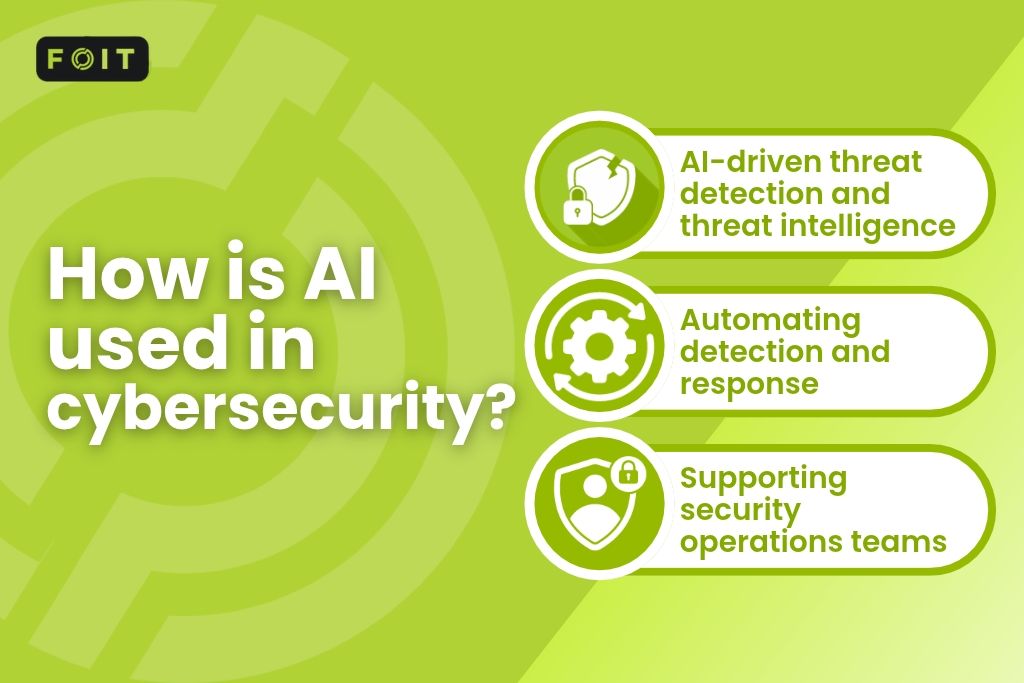
AI is used in cybersecurity to process far larger volumes of data than human analysts could review alone, then surface the events that matter most. Security teams rely on it to cut through noise, speed up investigation, and act on threats before they escalate.
AI-driven threat detection and threat intelligence
AI models analyse network traffic, user behaviour, and endpoint activity for patterns linked to known attack techniques. Combined with threat intelligence feeds, this can let AI systems map an unusual login or file change to attacker tactics and techniques documented in frameworks such as MITRE ATT&CK, which is a knowledge base and analytical reference rather than a live threat feed itself. Analysts get useful context, not just a raw alert.
Automating detection and response
Many AI-powered cybersecurity tools now automate parts of detection and response. Where configured and supported by the underlying tools, automated playbooks can isolate an infected device, disable a compromised account, or block malicious traffic rapidly after detection, often faster than a human analyst could respond manually.
These automated actions can also disrupt legitimate users if not carefully tuned, so most organisations review and adjust playbook rules over time.
Supporting security operations teams
AI is generally used to support analysts, not replace them. By automatically triaging alerts and filtering out false positives, it frees security operations teams to focus on the incidents that carry genuine risk.
What are the benefits of AI in cybersecurity for Australian businesses?
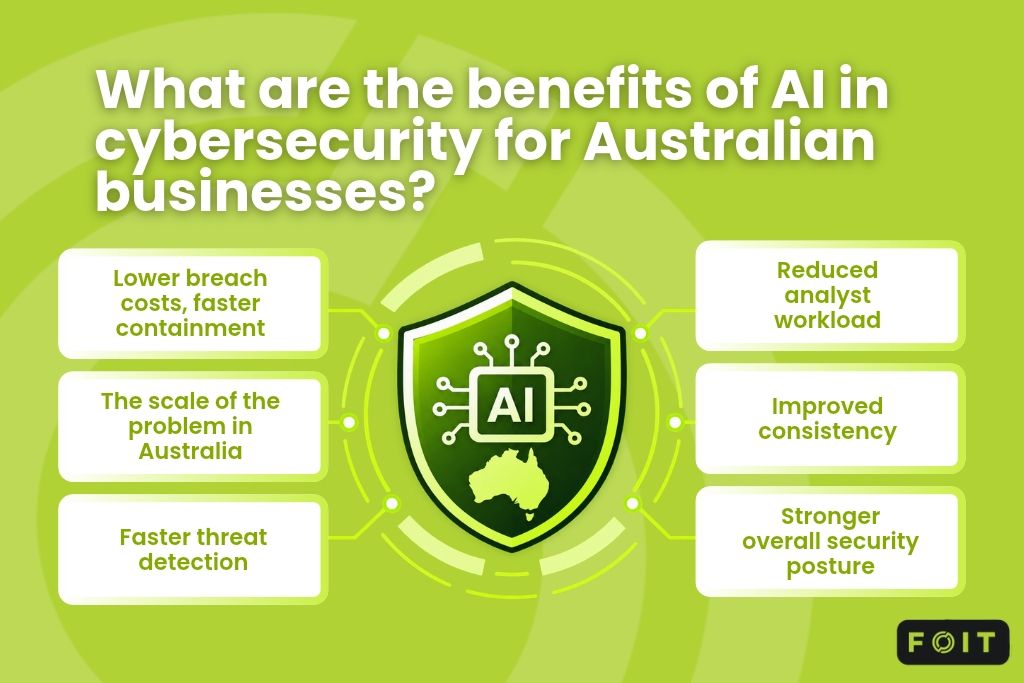
The benefits of AI in cybersecurity go well beyond faster alerts. For Australian organisations facing a persistent skills shortage and a growing threat landscape, AI offers a practical way to close some capability gaps.
It comes with new demands too. Governance, tuning, and data quality all need ongoing attention once AI is in place.
Lower breach costs, faster containment
IBM’s Cost of a Data Breach Report 2025 found that organisations using AI and automation extensively had lower breach costs. On average, their breaches cost USD 1.9 million less and were contained 80 days faster than organisations that did not use these technologies.
The global average breach cost also fell 9 per cent in the same study, from USD 4.88 million in 2024 to USD 4.44 million in 2025. This is a global finding, not proof that AI alone drove the improvement, and it should not be read as a direct measure of outcomes for Australian businesses.
The scale of the problem in Australia
Local context shows why this matters closer to home. According to the ASD’s ACSC Annual Cyber Threat Report 2024–25, the ACSC received over 84,700 cybercrime reports in FY2024–25, an average of one every six minutes.
The average self-reported cost of cybercrime per business report rose 50 per cent, to $80,850. This figure reflects the cost per report, not the cost of an average incident. Tools that help detect and contain incidents faster can reduce this financial exposure.
Other practical benefits include:
- Faster threat detection, since AI can analyse activity continuously or near real time, depending on the tool and configuration, rather than relying only on scheduled reviews.
- Reduced analyst workload, as automated triage filters out low-priority alerts.
- Improved consistency, because AI applies the same detection logic around the clock without fatigue.
- Stronger overall security posture, built through continuous monitoring and pattern recognition across the environment.
Key applications of AI-powered cybersecurity tools
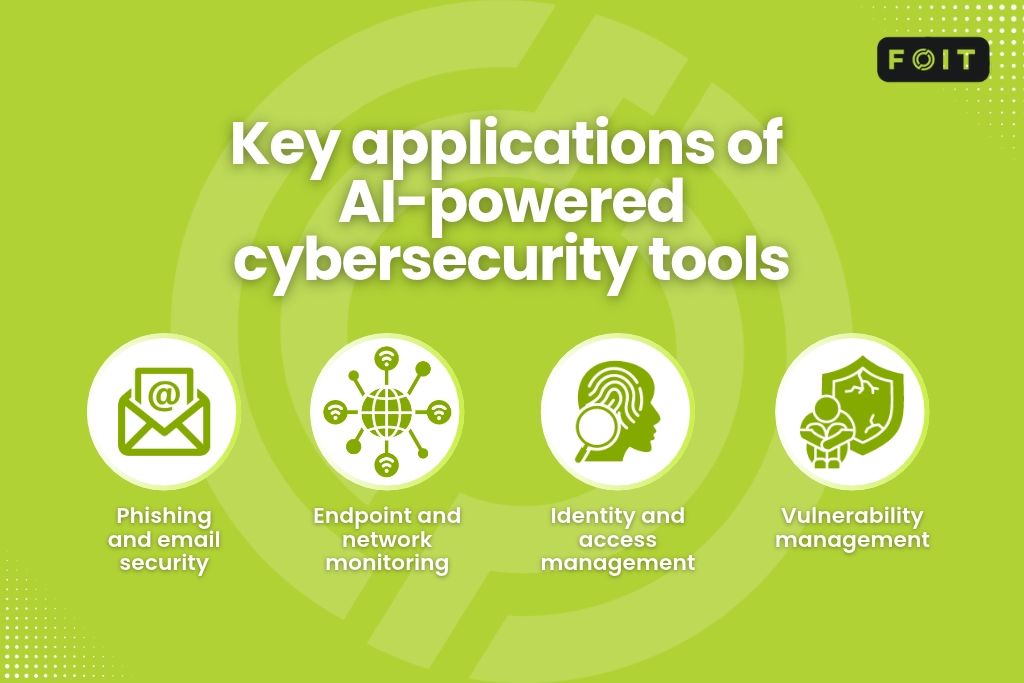
AI is now embedded across many areas of modern cybersecurity, from email protection to identity management. The following applications are among the most common ways businesses are putting AI to work today.
Phishing and email security
Generative AI has made phishing emails harder to spot, since attackers can produce more polished, personalised, and grammatically accurate messages at scale. In response, AI-powered email security tools analyse writing style, sender behaviour, and link patterns to help catch sophisticated phishing attempts that traditional filters often miss, though no tool can guarantee it will catch every attempt.
Endpoint and network monitoring
AI-driven endpoint detection and response (EDR) tools continuously monitor device activity for behaviour linked to malware or unauthorised access. Using a combination of behavioural telemetry, rules, and analytics, not AI alone, modern EDR can also detect fileless or living-off-the-land activity that never drops a file onto the system. On the network side, AI helps flag unusual traffic flows that may indicate an attacker moving laterally.
Identity and access management
AI is increasingly used to monitor login behaviour and flag anomalies, such as a login from an unusual location or device, that may indicate a compromised account. These anomalies are not always malicious, since VPN use, travel, and shared cloud services can trigger similar alerts, so flagged events still require investigation rather than automatic assumption of compromise.
Vulnerability management
AI tools help prioritise which vulnerabilities pose the greatest real-world risk by weighing exploitability, asset value, and exposure, rather than relying purely on generic severity scores. The quality of this prioritisation depends on accurate asset inventories, up-to-date vulnerability data, and reliable exposure context, so it helps security teams focus remediation effort where it matters most rather than replacing that judgement entirely.
How the main tool categories compare
Many mature security programs use a combination of these AI-powered cybersecurity tools rather than a single product.
Note that MDR is typically delivered as a managed service rather than a single product, so its actual capabilities depend on the provider and the underlying EDR platform it is built on.
Businesses assessing which combination suits their environment often start with a cybersecurity risk assessment. This identifies where automation would have the greatest impact before any new tooling is purchased.
What are the risks of AI in cybersecurity, and how can businesses manage them?
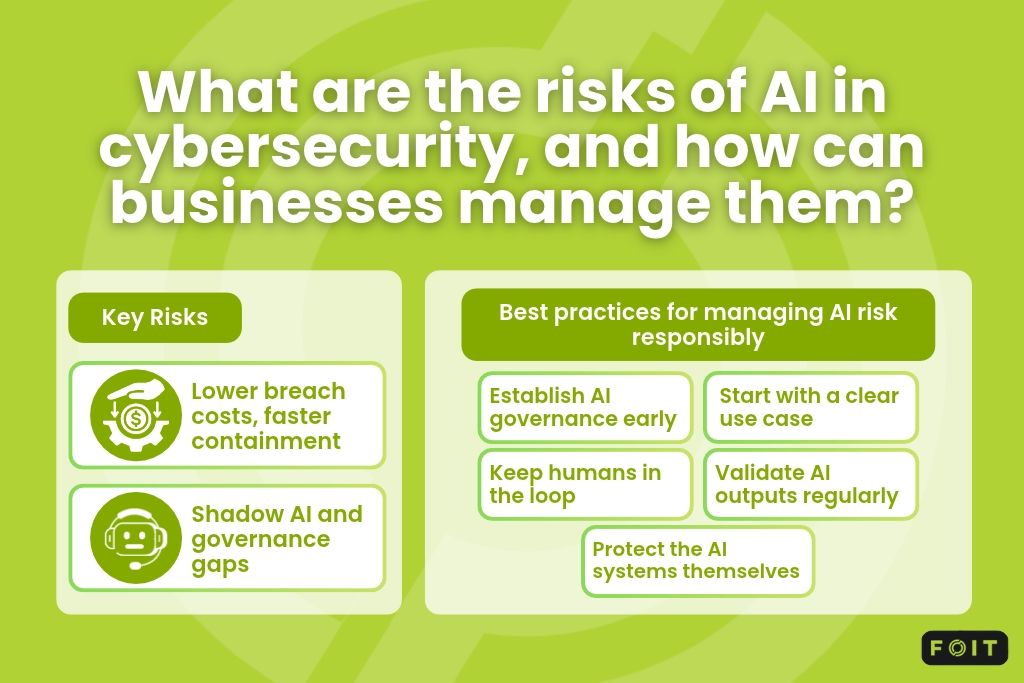
AI in cybersecurity is not without risk, and understanding these risks is part of using the technology responsibly. Both attackers and defenders are adopting AI, which is reshaping the threat landscape on both sides.
Adversarial and AI-driven attacks
Threat actors are also using AI, particularly generative AI, to craft convincing phishing content and deepfake scams. In IBM’s 2025 study, attackers were reported to have used AI in around 16 per cent (roughly one in six) of the breaches analysed.
This means AI cybersecurity tools need to focus on detecting the underlying malicious behaviour, identity compromise, and social-engineering indicators, regardless of whether AI was used to help create the attack.
Shadow AI and governance gaps
Unsanctioned or ungoverned use of AI tools within an organisation, often called shadow AI, is a significant governance concern. IBM reported that 20 per cent of organisations in its study experienced a breach involving shadow AI, with those breaches costing an average of USD 4.63 million, about USD 200,000 above the study’s global average.
Organisations with high levels of shadow AI had average breach costs USD 670,000 higher than those with low or no shadow AI, and 63 per cent of breached organisations either had no AI governance policy in place or were still developing one. Without clear oversight, staff experimenting with unapproved AI tools can unintentionally expose sensitive data.
Best practices for managing AI risk responsibly
A few practices consistently separate organisations that get strong results from AI from those that do not:
- Establish AI governance early. Clear policies on which tools are approved, and how they can be used, help prevent shadow AI risks before they emerge.
- Keep humans in the loop. AI should support analyst decisions, particularly for high-impact actions like isolating critical systems, rather than acting entirely without oversight.
- Validate AI outputs regularly. AI models can produce false positives or miss context, so periodic review helps maintain accuracy and trust in the system.
- Protect the AI systems themselves. As AI becomes core security infrastructure, it also becomes a target, so access controls around AI models and data are essential.
- Start with a clear use case. Targeting a specific problem first, such as phishing volume or alert fatigue, tends to deliver better results than adopting AI broadly from day one.
What is the future of AI in cybersecurity?
The next phase of AI in cybersecurity is likely to be shaped by agentic AI: systems being developed to autonomously investigate and respond to threats with minimal human input, within defined guardrails. Rather than simply flagging an alert, agentic AI tools are being designed to independently gather context, correlate related events, and carry out predefined response actions.
Generative AI is also expected to play a larger role in security operations, from summarising complex incidents in plain language to helping less experienced analysts interpret technical findings. As adoption grows, governance and responsible AI practices will likely matter to vendors and regulators as much as detection accuracy itself.
In Australia, this includes guidance such as the Australian Signals Directorate‘s advice on securely engaging with AI, alongside broader government AI policy that currently applies primarily to Commonwealth entities rather than automatically extending to all private businesses.
Building a stronger security posture with AI
AI has become a valuable part of modern cybersecurity, helping organisations detect threats earlier, respond faster, and reduce the workload on security teams. However, it works best as an extension of strong cybersecurity fundamentals, supported by appropriate governance, reliable data, and human oversight.
For Australian businesses, the focus should be on where AI can address genuine security needs rather than adopting new tools simply because they use AI. At FOIT, we see this as part of a broader cybersecurity strategy, where an organisation’s existing risks, systems, and security capabilities are assessed first to determine where AI-powered cybersecurity solutions can provide practical value.
Frequently asked questions
Is AI replacing human cybersecurity professionals?
No. AI is generally used to support human analysts by automating repetitive tasks and highlighting priority alerts. People remain responsible for investigation, decision-making, and strategy, and most vendors position AI as an assistant rather than a replacement for their team.
How do small businesses start using AI cybersecurity tools?
A practical starting point for many small businesses is AI-enhanced email security or a managed detection and response (MDR) service, since these typically require less internal expertise to operate than building an in-house capability. A cybersecurity risk assessment can also help identify which area of the business would benefit most from automation first.
Can AI in cybersecurity stop all cyber attacks?
No security tool, including AI, can guarantee complete protection. AI can improve detection speed and help prioritise alerts, but it works best as one layer within a broader, well-governed security strategy that also includes staff training, patching, and incident response planning.
What is shadow AI and why does it matter?
Shadow AI refers to AI tools used within an organisation without formal approval or oversight, such as staff pasting sensitive data into a public chatbot. It matters because ungoverned AI use has been linked to higher breach costs. IBM found that organisations with high levels of shadow AI had average breach costs USD 670,000 higher than those with low or no shadow AI, and that breaches involving shadow AI cost an average of USD 4.63 million overall.
Do AI cybersecurity tools require specialist staff to manage?
Some do, particularly complex SIEM or XDR platforms that need tuning and ongoing rule development. Many organisations avoid this overhead by managing AI cybersecurity tools through a third-party provider rather than hiring specialist AI security staff internally.
How much do AI cybersecurity tools cost?
Pricing varies widely depending on the tool category, number of users or endpoints, and whether it is self-managed or delivered through a provider. Many AI-enhanced email security and EDR tools are priced per user or per device each month, while broader platforms such as SIEM or XDR are often priced on data volume or a managed service subscription.
How is AI cybersecurity different from traditional, rule-based security tools?
Traditional security tools often rely heavily on signatures, rules, and known indicators, while AI-enabled tools add behavioural, statistical, and machine-learning analysis on top of this. In practice, modern security platforms generally combine both approaches rather than replacing rules and signatures entirely, which helps them catch known threats as well as behaviour associated with previously unseen ones.
What is agentic AI in cybersecurity?
Agentic AI refers to systems being developed to independently investigate an alert, gather supporting context, and carry out a predefined response action, such as isolating a device, with minimal human input. Rather than reasoning in a general sense, these systems use models to interpret context and select from a defined set of permitted actions, and should operate within strict controls and escalation paths rather than acting entirely autonomously.