What Is AI Governance? A Practical Guide for Australian Organisations

AI governance is no longer a technical afterthought, because AI now sits inside everyday business tools, whether or not anyone has formally approved it.
AI governance is the set of policies, roles, processes and controls that guide how an organisation selects, builds, deploys and monitors artificial intelligence. It keeps AI systems safe, fair, and accountable, and helps demonstrate compliance with applicable legal and regulatory obligations.
What is AI governance?
AI governance aims to guide AI development and deployment so that AI systems stay safe, fair and accountable across the whole AI lifecycle, from the first idea to retirement. It applies whether AI is developed in-house or supplied by vendors.
Responsible AI governance answers four questions: who is accountable, what is permitted, how risk is assessed, and how performance is checked over time. It helps organisations identify, manage and evidence compliance with legal obligations, but it does not guarantee compliance on its own.
How does AI governance differ from AI ethics and data governance?
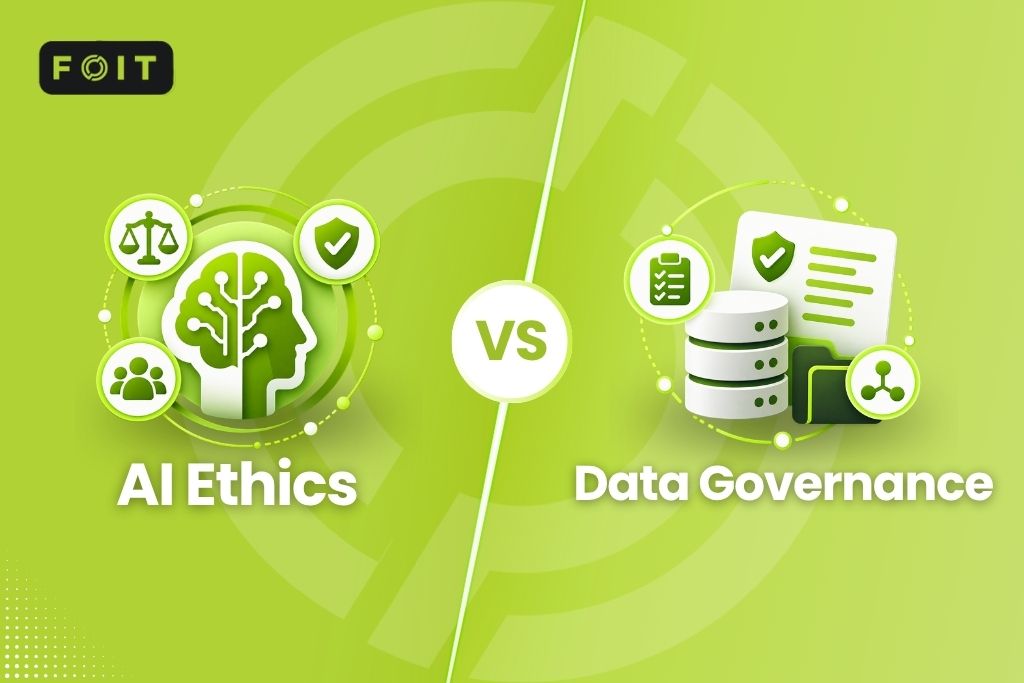
AI principles provide the values, such as fairness, transparency and human oversight, and governance turns AI ethics into enforceable policies, decision rights and evidence. Data governance manages data quality, privacy and access, and AI governance adds controls specific to AI, such as bias testing.
In practice, the three overlap, and many organisations manage them through shared committees and registers.
What does an AI governance framework include?
A governance framework is a structured set of principles, processes and controls, ensuring that AI systems meet the same standard across the organisation. No single official list applies to every organisation, but five components are common:
- Accountability: an accountable senior leader and clear owners for each material AI system
- Policy: written rules on acceptable use, data handling and procurement
- Risk management: classification of each use case by impact, with recorded controls
- Assurance: testing, documentation and an audit trail
- Monitoring and response: review cycles, incident thresholds and escalation paths
Why AI governance matters for organisations
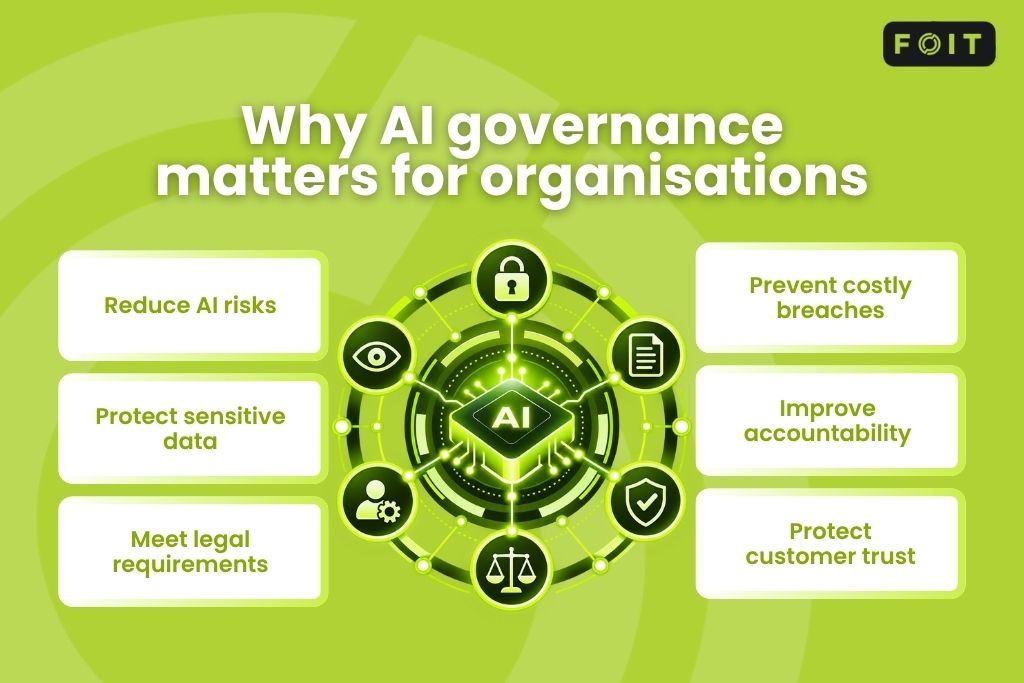
As generative AI continues to spread through everyday business software, AI governance matters because adoption is moving faster than the controls around it. As AI capabilities grow, the potential risks associated with AI extend into security, legal and reputational exposure.
How much does ungoverned AI cost?
IBM’s 2025 Cost of a Data Breach Report found that 63% of breached organisations surveyed either had no AI governance policy or were still developing one. Among the 13% of organisations that reported a breach involving AI models or applications, 97% lacked proper AI access controls.
These findings show an association between weak governance and security exposure. They do not prove that missing controls alone caused a particular breach.
IBM also reported that organisations with high levels of shadow AI had average breach costs of USD 4.74 million, compared with USD 4.07 million where such use was low or absent, a difference of USD 670,000.
How does EU AI regulation affect Australian organisations?
The EU AI Act establishes a risk-based structure and aims to regulate AI according to the potential harm a system may create. It can reach organisations outside the EU, including Australian businesses, where they place AI systems on the EU market or fall within other territorial links.
Businesses with EU-facing products should obtain legal advice on whether the Act applies to their role and use case.
The Digital Omnibus on AI entered into force on 27 July 2026 and set the current timetable:
- 2 August 2026: several Article 50 transparency duties began applying, with generative AI systems already on the market given until 2 December 2026 to meet the machine-readable content marking requirement
- 2 December 2027: obligations apply to stand-alone Annex III systems
- 2 August 2028: obligations apply to high-risk systems embedded in regulated products
Penalties vary by contravention. For some obligations, the maximum reaches EUR 15 million or 3% of worldwide annual turnover, whichever is higher (or whichever is lower for SMEs and start-ups).
What is Australia’s current position on AI regulation?
Australia does not currently have a single economy-wide statute equivalent to the EU AI Act. The National AI Plan, released in December 2025, relies substantially on existing laws, sector regulators and voluntary guidance.
Privacy, consumer, employment and anti-discrimination obligations may therefore already apply to how AI is used, depending on the use case.
On 15 July 2026, the Prime Minister announced that the Government will establish Australian Standards for AI, expected to be legislated in early 2027, alongside new standards for large data centres and copyright protections for creative works used to train AI. An Office of AI was also set up within the Department of the Prime Minister and Cabinet. Until that legislation passes, the national AI guidance remains voluntary.
Which standards for AI and governance frameworks should organisations use?
Several established standards for AI can anchor a governance framework, and most are voluntary. A risk-based approach to AI usually works better than a fixed checklist, and the right starting point depends on organisation size, customer expectations and EU market exposure.
What are the six essential practices in Australian AI guidance?
The National AI Centre’s Guidance for AI Adoption, released in October 2025, condenses the earlier ten voluntary guardrails into six practices: accountability, impact planning, risk management, information sharing, testing and monitoring, and human control. A foundations version suits early adopters, and an implementation version aligns with ISO/IEC 42001 and the NIST AI Risk Management Framework (RMF).
How do the main frameworks compare?
NIST’s AI RMF, released in January 2023, is a voluntary framework built around four functions: Govern, Map, Measure and Manage. ISO/IEC 42001, published in December 2023, is the first AI management system standard, and certification is voluntary and performed by independent certification bodies rather than ISO itself.
Implementing AI governance: a step-by-step approach
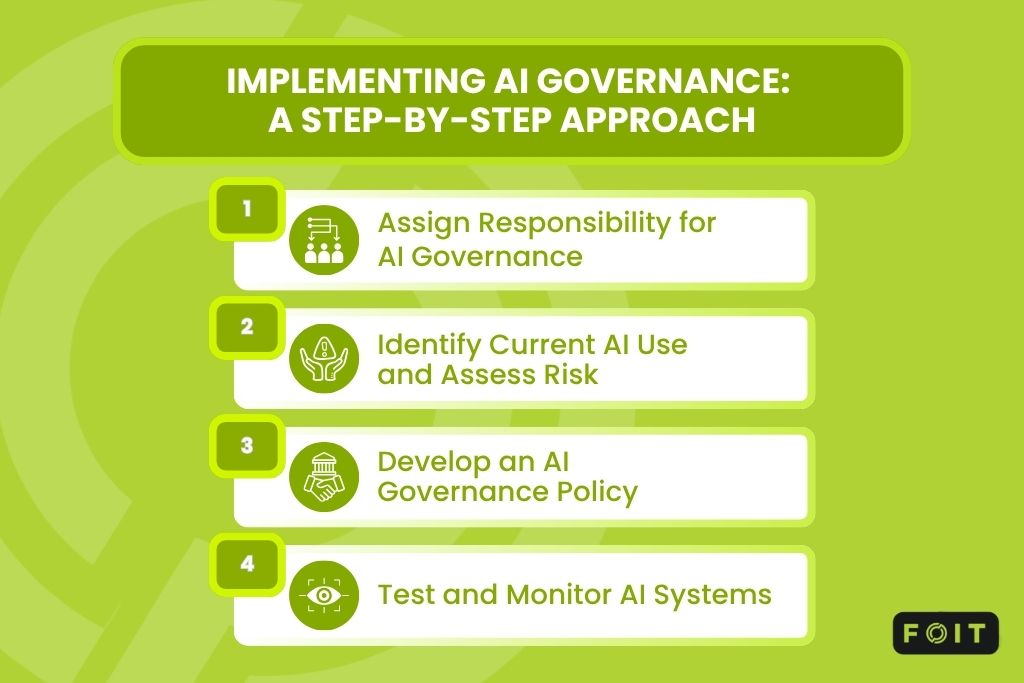
Implementation works best as small, evidenced steps rather than one large project. The steps below are recommended practice rather than legal requirements, and they suit an AI governance program of any size.
Step 1: Who is responsible for AI inside the organisation?
Each material use of AI should have a clearly identified business owner, and a senior leader with sufficient authority should hold overall accountability. Decision rights across IT, risk, legal, and business teams should be documented.
Step 2: How does an organisation inventory current AI use and rate its risk?
The first task is a register of every AI system in use, including AI projects at pilot stage and AI applications embedded in existing software. Each entry records purpose, data, owner and vendor.
Each AI use case is then rated lower or higher risk based on who could be affected, with higher-risk cases such as high-risk AI in hiring receiving deeper testing and human review.
Step 3: What should an AI governance policy cover?
- Governance policies work best when they are short and specific. The policy should cover:
- Approved and prohibited uses
- Data that may and may not be entered into AI tools
- Approval steps for new AI use cases
- Whether disclosure to affected people is legally required, contractually expected or appropriate for transparent AI
- Incident reporting and escalation
Step 4: How should AI systems be tested and monitored?
AI systems should be tested for accuracy, robustness, bias and security before go-live, then reviewed on a risk-based schedule: at least annually for the program overall, and sooner after material changes, incidents or model updates.
Teams should monitor AI performance throughout the AI lifecycle, and human oversight should define where a person must review or overrule AI output.
How does AI governance connect to cybersecurity?
AI governance and cybersecurity overlap wherever AI systems touch sensitive data or business systems. This becomes particularly important with AI automation, where systems may trigger workflows, access business applications, or take actions with limited human involvement.
Least-privilege access, data classification and logging should apply to AI systems as they do to any other business system. IBM’s 2025 report also recommends protecting AI agent identities with the same rigour as human identities, including managing their credentials and monitoring their activity. In practice, that means granting agents access only to the specific task or workflow they are designed for.
Governance best practices for a workable AI strategy
Effective governance shows up in daily decisions rather than in a policy folder. A workable AI governance strategy favours clear ownership and small repeatable steps over lengthy documents.
What are the best practices for effective AI governance?
- Begin with an inventory rather than a policy
- Adopt an established framework instead of writing one from scratch
- Scale controls to the level of risk
- Build responsible AI practices, such as testing and human review, into normal delivery
- Train staff on approved use
Building an AI governance program that supports AI innovation
Clear owners, a current register, proportionate controls and regular review give organisations a workable way to use AI with confidence. Established options such as the NIST AI RMF, ISO/IEC 42001 and Australia’s national guidance reduce the need to design governance programs from scratch.
At FOIT, we treat governance as an extension of the security and risk work already carried out for clients, rather than a separate discipline. We recommend starting with three practical steps: identifying where AI is already in use, setting an approved-use policy, and applying existing access and data protection controls to AI systems.
Taken together, these steps let organisations use AI responsibly and keep responsible AI innovation moving, without waiting for a large program to be designed first.
Frequently asked questions
What is AI governance in simple terms?
In simple terms, it is the set of rules, roles and checks that determine how an organisation approves, uses and oversees AI. It answers practical questions such as who signs off a new tool, what data staff may enter into it and what happens when an output is wrong.
The aim is to capture the benefits of AI while keeping safety, fairness and legal exposure under control.
What is an AI governance framework?
An AI governance framework combines principles, processes and controls into a repeatable structure for approving, risk-rating, testing and reviewing AI. Established examples include ISO/IEC 42001, NIST’s risk management framework and the Australian six-practice guidance.
Most organisations adopt or adapt one of these rather than writing a framework from scratch.
Is AI governance mandatory in Australia?
There is no general legal duty to adopt a formal governance program, and the national guidance is voluntary. However, existing privacy, consumer, employment and anti-discrimination laws still apply to how AI is used, so an organisation remains answerable for AI-assisted decisions. From 10 December 2026, organisations covered by the Privacy Act must also explain in their privacy policies when personal information is used in substantially automated decisions that could significantly affect an individual’s rights or interests. Legislated Australian Standards for AI are also expected in early 2027.
Governance is the practical way to show that those obligations are being met.
What is the difference between AI governance and responsible AI?
The goal is responsible AI development and use that is fair, safe, transparent and accountable. Governance is the operating structure that delivers it, through owners, policies, testing and evidence.
An organisation can publish principles without governance, but it cannot demonstrate that it follows them without it.
What is shadow AI?
It refers to AI used outside approved organisational processes or oversight, such as staff pasting client information into an unapproved chatbot. It matters because sensitive data can leave the organisation without security visibility.
IBM’s 2025 research associated high levels of it with higher average breach costs, so an approved-tools list and clear data rules are common first controls.
Does AI governance apply to small businesses?
Yes, although it can be lighter. Small businesses use AI through email, accounting and chat software. Consumer law applies regardless of size, and the Privacy Act covers businesses with annual turnover above $3 million plus some smaller ones, such as health service providers.
A named owner, a simple register of AI tools, a short use policy and a rule about what data may be entered are usually enough to begin.
What are the main benefits of AI governance?
Benefits include reduced legal and security exposure, stronger customer trust and better decisions about where to use AI. It also speeds up approvals because teams know the rules before a project starts.
Clear governance gives boards and executives evidence that oversight is happening, rather than an assumption that it is.
How long does it take to set up an AI governance program?
For a small or mid-sized organisation with a limited AI footprint, FOIT’s experience is that a basic owner, register, approved-use policy and intake process can often be established within weeks. The timetable depends on the number of systems, data sensitivity, regulatory exposure and existing risk maturity.
Formal certification, such as ISO/IEC 42001, takes longer because it involves an independent audit.