
ITSM: A Guide to IT Service Management

What is ITSM (IT service management)?
IT Service Management (ITSM) is a strategic approach to designing, delivering, managing, and improving the way organisations use information technology. Unlike traditional IT support that simply fixes technical issues, ITSM focuses on delivering value through technology services that align with business objectives.
ITSM Frameworks and Methodologies
1. ITSM: The strategic approach
ITSM provides the overarching strategy for managing IT services. It establishes how organisations plan, deliver, and maintain their IT services while ensuring alignment with business objectives. Through ITSM, organisations create standardised processes that optimise resources and generate measurable business value.
2. ITIL: The industry standard
ITIL stands as the most widely adopted ITSM framework globally. Its comprehensive approach covers the entire service lifecycle through five core areas:
- Service strategy and design
- Service transition management
- Service operation protocols
- Continuous service improvement
- Stakeholder value optimisation
3. DevOps integration
DevOps brings agility and speed to ITSM practices. This methodology emphasises collaboration between development and operations teams while maintaining service quality. DevOps practices enhance ITSM by introducing automated testing, continuous integration, and rapid deployment capabilities within the service management framework.
What are important ITSM frameworks?
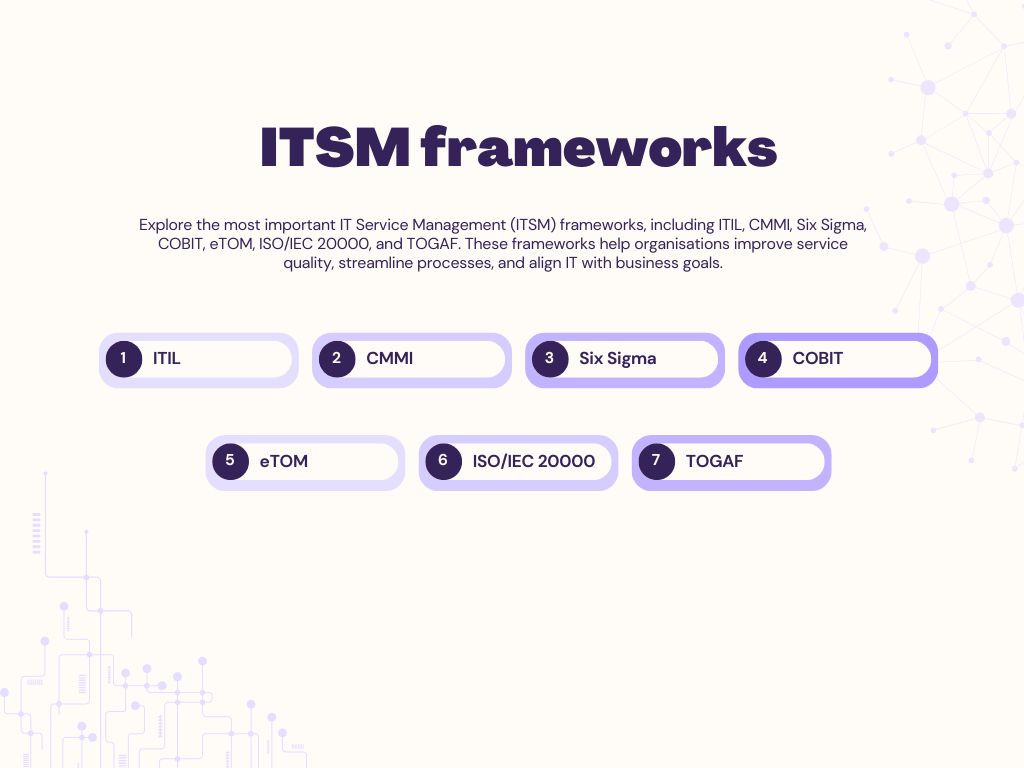
ITIL
The Information Technology Infrastructure Library forms the foundation of IT service management. This comprehensive framework provides detailed practices for aligning IT services with business needs. Organisations worldwide use ITIL to standardise service delivery and improve operational efficiency through structured processes and continuous improvement cycles.
CMMI
The Capability Maturity Model Integration helps organisations improve their service delivery processes. This framework focuses on process maturity and capability assessment, enabling organisations to evaluate and enhance their service management practices systematically. CMMI provides clear pathways for process improvement and organisational development.
Six Sigma
Six Sigma methodology brings data-driven quality improvement to IT service management. This framework reduces process variation and eliminates defects in service delivery. Organisations implement Six Sigma to achieve measurable quality improvements and optimise service performance through statistical analysis.
COBIT
Control Objectives for Information and Related Technologies bridges the gap between technical issues and business risks. This governance framework helps organisations maintain effective IT controls while ensuring regulatory compliance. COBIT provides tools for measuring IT performance and managing technology investments effectively.
eTOM
The enhanced Telecom Operations Map specialises in telecommunications service management. This framework standardises business processes and terminology across telecom operations. Organisations in the telecommunications sector use eTOM to improve service delivery and maintain operational consistency.
ISO/IEC 20000
This international standard establishes requirements for IT service management systems. Organisations use ISO/IEC 20000 to demonstrate their commitment to quality service delivery through certified processes. The standard ensures consistent service management practices across global operations.
TOGAF
The Open Group Architecture Framework guides enterprise architecture development. This framework helps organisations design and implement IT services that align with business strategies. TOGAF provides structured methods for planning, implementing, and governing enterprise IT architecture.
Key ITSM Processes and Services

Service request management
Service request management streamlines how users request and receive IT services. This process handles everything from password resets to software installations through standardised procedures. Organisations use service catalogs to define available services and set clear expectations for delivery times and requirements.
Incident and problem management
Incident management focuses on quickly restoring normal service operations when disruptions occur. Problem management takes this further by investigating and addressing root causes of recurring incidents. Together, these processes reduce downtime and prevent future service disruptions through systematic analysis and resolution.
Change management
Change management controls how modifications to IT services are planned, tested, implemented, and reviewed. This process ensures changes don’t disrupt existing services while enabling necessary improvements. Organisations use structured approval workflows to evaluate risks and impacts before implementing changes.
Knowledge management
Knowledge management captures, organises, and shares technical expertise across the organisation. This process builds a searchable knowledge base of solutions, reducing resolution times and ensuring consistent service delivery. Support teams use this shared knowledge to solve issues faster and maintain service quality.
IT asset management
IT asset management tracks and optimises the use of technology assets throughout their lifecycle. This process monitors hardware and software from procurement through retirement, ensuring compliance and cost efficiency. Organisations use asset management to make informed decisions about technology investments and maintenance.
Configuration management
Configuration management maintains accurate records of IT infrastructure components and their relationships. This process provides visibility into how system changes might affect other services. Organisations rely on configuration management to understand dependencies and prevent service disruptions during updates or changes.
Benefits and Value of ITSM (IT service management)
Business advantages
ITSM transforms IT from a cost center into a strategic business asset. Organisations gain improved service reliability while reducing operational costs through standardised processes. Strategic resource allocation and measured performance metrics provide clear visibility into IT investments and their business impact. Companies also maintain better compliance standards through documented procedures and consistent service delivery methods.
IT department improvements
IT teams operate more efficiently with structured workflows and clear objectives. Service delivery becomes predictable through standardised processes, while automated systems reduce manual workload. IT departments can demonstrate their value through measurable metrics and consistent service quality. Staff productivity increases as teams spend less time on routine tasks and more on strategic initiatives that drive innovation.
User experience enhancements
Users benefit from reliable, consistent IT services that align with their needs. Quick response times and transparent request tracking improve satisfaction levels. Self-service options and knowledge bases empower users to solve common issues independently. Regular feedback channels ensure services continue to evolve based on actual user requirements and changing business needs. The structured approach to service delivery creates predictable outcomes and clearer expectations for all stakeholders.
ITSM Efficiency and Implementation
Resource optimisation
Organisations maximise their IT investments through strategic resource allocation and utilisation. Proper ITSM implementation ensures teams direct their efforts toward high-priority activities while maintaining service quality. Advanced resource planning helps prevent bottlenecks and reduces waste across IT operations, creating sustainable operational efficiency.
Automation capabilities
Modern ITSM platforms automate routine tasks and standardise service delivery. Support teams can process requests faster through automated workflows and triggered responses. This automation reduces human error, speeds up service delivery, and frees staff to focus on complex issues requiring specialised attention.
Process improvements
Systematic analysis of service delivery identifies opportunities for enhancement. Organisations streamline workflows by removing unnecessary steps and optimizing critical processes. Regular review cycles ensure processes remain efficient and adapt to changing business requirements, maintaining operational excellence through continuous refinement.
Measurement and reporting
Data-driven insights guide service improvements and resource allocation decisions. Organisations track key performance indicators to measure service quality, response times, and resource utilisation. Regular reporting helps identify trends, predict potential issues, and validate the effectiveness of IT service delivery strategies.
Best practices for success
Successful ITSM implementation requires clear goals, stakeholder support, and phased deployment plans. Organisations should:
- Start with core processes and expand gradually
- Train staff thoroughly on new systems and procedures
- Monitor performance metrics consistently
- Maintain open communication channels
- Update processes based on feedback and results
Frequently Asked Questions
What’s the difference between ITSM and ITIL?
ITSM represents the overall practice of managing IT services to deliver value to organisations. ITIL, however, provides specific guidelines and processes within ITSM. Think of ITSM as the profession of managing IT services, while ITIL serves as a detailed instruction manual for implementing these services effectively.
How do I choose the right ITSM tool?
Select an ITSM tool based on your organisation’s specific needs, size, and complexity. Consider factors such as:
- Current service management maturity
- Required integration capabilities
- Budget constraints
- Team size and expertise
- Scalability requirements
What are the first steps to implementing ITSM?
Start your ITSM journey by assessing current IT service delivery processes and identifying improvement opportunities. Begin with essential services like incident management and service requests. Create a phased implementation plan that prioritises quick wins while building toward comprehensive service management. Document existing processes and engage stakeholders early to ensure successful adoption.
Is ITSM relevant for small businesses in Australia?
ITSM remains valuable for small businesses by providing structured approaches to managing IT services efficiently. Small organisations can implement core ITSM practices scaled to their needs, focusing on essential processes that deliver immediate value. This approach helps small businesses maintain reliable IT services while preparing for growth.